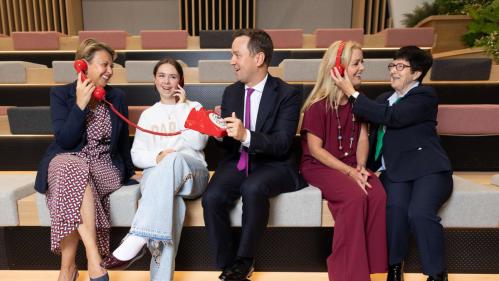

Every parent of a newborn in Ireland knows the heelprick test. The tiny prick on your baby's foot in those first few days of life, the little bloodspot card that gets sent off quietly while you're still in a fog of feeds and nappy changes and wondering when you last slept. It feels almost unremarkable in the moment. But that small test has just become significantly more powerful — because from now on, it includes screening for Spinal Muscular Atrophy.
SMA Ireland confirmed today that the first babies in Ireland are now being tested for Spinal Muscular Atrophy (SMA) through the national newborn bloodspot screening programme. It's a milestone that families affected by this devastating condition have been fighting towards for years, and the weight of what it means for future parents is enormous.
What is SMA and why does early detection matter so much?
SMA is a rare genetic condition that causes severe muscle degeneration. In its most serious form, it affects a baby's ability to move, swallow, speak and even breathe. Without early intervention, it can be fatal by the age of two. Around six babies are born with SMA in Ireland every year and until now, by the time symptoms appeared and a diagnosis was reached, irreversible damage had often already been done.
There are cutting-edge treatments available in Ireland that can dramatically mitigate SMA's effects — but timing is everything. The sooner a child is diagnosed and treated, the better their outcome. That's the whole point of getting SMA into the heelprick test.
Jonathan O'Grady, Director of SMA Ireland, described it as "excellent news for new and expectant parents and indeed for everyone who will have a baby in Ireland in the future," adding that SMA Ireland members and the families they represent have been "campaigning about this for years." He also applauded the work of Minister for Health Jennifer Carroll MacNeill, the Department of Health and the HSE in making it happen.
The families who know exactly what this means
Behind this announcement are real families who have lived on both sides of the diagnostic divide — and their words are the ones that stop you in your tracks.
Liz McMahon and Dave Ryan have two boys, Luke (aged 8) and Sean (aged 6), both of whom have SMA. Luke was diagnosed at eight weeks old, but by the time treatment began, irreversible damage had already occurred. Sean, born two years later, was diagnosed in utero and treated within days of being born. He is living without disabilities. The same condition. Two completely different outcomes, separated only by timing.
"We have lived the reality of both late and early diagnosis," Liz said. "The difference is life-changing. Knowing that every baby will now be screened means other families will not have to endure that uncertainty. Screening gives children the best chance from the very beginning."
Bróna Noonan, whose four-year-old son Donnacha has SMA, said the decision "will change and save lives," adding: "For families like mine, this is the progress we have fought years for and now it means future parents will never have to hear the words 'it's too late'."
Laois footballer Aisling Donoher, whose son Dan has SMA, said her family's understanding of the condition only came after he showed symptoms — "a reality we wouldn't wish on any family." She called today "a day that has been a long time coming."
Stephanie Vaz Vieira, mum to four-year-old Theo who is living with SMA, put it simply: "No parent should have to go through the rollercoaster journey of trying to get a diagnosis of SMA for their child, like we did for Theo. For the families of the six babies who will be born with SMA this year and every year, they will receive a diagnosis on time and receive the treatment which can stop SMA in its tracks."
What this means for Ireland's newborn screening programme
With the addition of SMA and another rare condition, SCID, to the national bloodspot screening programme, Ireland now screens newborns for eleven diseases in total. SMA and SCID will also be the first genetic tests performed as part of the heelprick test — a significant step forward for rare disease diagnosis in this country.
For the estimated 300,000 people in Ireland living with rare diseases, today's news represents real momentum. SMA Ireland and other advocates are hopeful that the government will continue to honour its commitment to transforming care for those affected by rare conditions.
Giulia Conti, Novartis Ireland Country President, said the company was "proud to go further, supporting initiatives that can make a meaningful difference to the lives of children with SMA and their families," noting that early diagnosis through newborn screening "enables earlier access to treatments and better long-term outcomes."
If you'd like to find out more about SMA or the work of SMA Ireland, you can visit smaireland.ie.
This activity is supported by Novartis Ireland. SMA Ireland is an independent organisation.