I didn't see it coming.
One minute I was coasting through my thirties with skin that more or less looked after itself, and the next — somewhere between 39 and 41 — something shifted.
It wasn't dramatic. That's almost the worst part. It was subtle enough that I kept second-guessing myself. My skin felt thinner. Drier. Less bouncy. The glow I used to take for granted started to fade, replaced by a flat, tired dullness that no amount of highlighter could fix. Makeup stopped sitting the way it used to. I'd catch my reflection in a shop window and feel like I was looking at a stranger.
Nobody warned me about this bit.
I'd later learn there's a word for what was happening: perimenopause. The quiet, unglamorous stage before menopause, when hormones start fluctuating and the knock-on effects ripple through everything — including your skin. Collagen production slows down. Elasticity weakens. Hydration gets harder to hold onto. The scaffolding underneath the surface, quite literally, starts to loosen.
But at the time, I had none of that language. I just knew something was off — and I did what most women I know do.
I threw money at it.
Expensive creams. Viral serums. "Miracle" oils that TikTok swore by. I upped my water intake, cleaned up my diet, booked the occasional facial, dabbled in a couple of aesthetic treatments. Each one promised a lot and delivered… some of it. For a week. Maybe two.
Nothing lasted. Nothing actually touched whatever was happening underneath.
And somewhere along the way — after one too many disappointments and one too many depressing mirror moments — I found myself seriously considering Botox.
Not because I wanted it. Not because I'd ever pictured myself going down that road. But because I genuinely thought I'd run out of options.
That's when a friend mentioned SaolSkin.
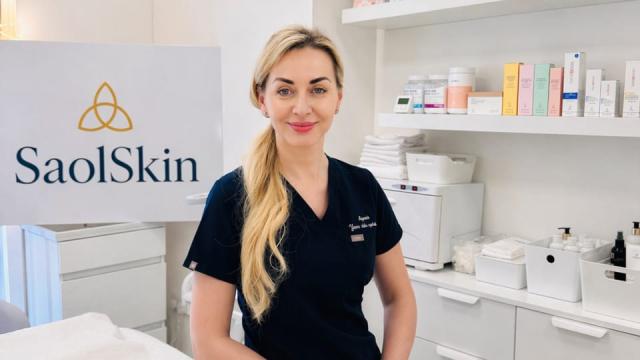
She'd been going to a clinic in Swords, run by a therapist called Agnes, and she couldn't stop talking about it. Not in the usual "oh my God you have to try this" way — more like someone who'd quietly figured something out, and wanted to share it.
So I booked in.
That appointment changed how I think about my skin full stop.
I walked into SaolSkin on a grey Tuesday afternoon assuming I already knew what to expect: the usual spiel, the gentle upsell, an appointment card pressed into my hand before I'd even got my coat off.
That's not what happened.
Agnes — who founded SaolSkin and runs it herself — didn't open with a treatment menu. She opened with questions. About my skin history. My hormones. Sleep. Stress. What I'd tried. What hadn't worked. What I'd actually noticed in the mirror, versus what other people kept telling me to "fix".
And then, before she suggested a single thing, she explained what was going on underneath.
This was the bit no one had ever properly spelled out for me. The fact that from our mid-thirties onwards, the rate at which skin produces collagen starts to drop — and keeps dropping. That oestrogen plays a far bigger role in skin health than most of us realise, and that as it starts to fluctuate in perimenopause, the scaffolding underneath the surface quietly degrades faster than the body rebuilds it.
Creams sit on top of all that. Which is fine for the surface. But the actual structural problem is happening deeper down, in the dermis. No €90 serum, no matter how viral, is reaching it.
What can reach it, she explained, is medical microneedling.

The science, minus the jargon
The idea is almost counter-intuitive: you trigger a controlled, microscopic "injury" in the skin, and the skin responds by rebuilding itself — stronger, thicker and more elastic than before.
Here's the short version. Very fine needles create tiny channels through the epidermis and down into the dermis. The body reads this as right, time to repair, and kicks off a cascade of natural responses — the release of platelet-derived growth factors, fibroblast activity, and, the one we all actually care about, the production of fresh new collagen and elastin.
This is your own collagen. Not injected. Not borrowed. Not squeezed out of a tube. Your skin makes it, because the treatment has convinced it to.
That distinction is the whole point. Botox paralyses. Fillers plump from the outside. Microneedling rebuilds from the inside out.
Not all microneedling is the same
Here's the bit I genuinely didn't know walking in.
"Microneedling" as a word covers an enormous spread, and most of what the public has seen of it sits at the low end. At one extreme you've got the home derma-rollers flogged online for the price of a pizza — the little spiked wheels you drag across your face after a glass of wine and hope for the best. They can't hit a consistent depth, they don't trigger the biological response a proper treatment does, and without sterile single-use heads they're a real infection risk.
Somewhere in the middle sit the motorised "needling pens" that have popped up in beauty salons over the last few years — a step up, certainly, but often without medical certification, proper depth control, or the hygiene engineering that keeps a clinical treatment clinical.
And then there's medical microneedling — which is a different thing entirely. Properly certified equipment, clinically studied, used in dermatology clinics across Europe for years. The depth is precise, the treatment is controlled, every needle cartridge is single-use and sealed, and the results are backed by peer-reviewed data rather than Instagram testimonials.
This is the category SaolSkin operates in, and it matters.
Honestly, this was the thing I'd missed. I'd quietly written microneedling off years ago based on a rubbish roller a friend had talked me into — which, it turns out, is a bit like writing off dentistry after a bad experience with a DIY whitening kit.
Agnes mapped out a plan of four sessions, spaced four weeks apart — the standard protocol for giving the skin enough time to do its collagen work between treatments.
The first session
Look, I'll be honest: I was nervous.
The word "needle" in a treatment name will do that to you, no matter how many times you've been told it's a proper clinical procedure. I arrived with my shoulders around my ears and a running internal monologue of why am I doing this to myself.
Agnes was completely unfazed. She walked me through exactly what she'd be doing, start to finish, and mentioned — almost in passing — that for most clients no numbing is needed at all. It's there as an option for anyone particularly anxious or sensitive, but it isn't a routine part of the treatment, and most women don't ask for it. I decided to go without.
Here's the bit that surprised me. The appointment itself runs to about an hour and fifteen minutes, but the needling part — the bit I'd spent the whole week nervously picturing — is only around twenty of those minutes. The rest of the time is the full care wrapped around it: a proper cleanse, skin prep, the treatment itself, and the calming, nourishing post-treatment steps that settle the skin and help it get the most out of what's just been stirred up underneath.
That framing alone shifted something for me. It didn't feel like being processed through a treatment. It felt like being properly looked after.
As for the needling itself: not the drama I'd built it up to be. The sensation is odd — a kind of prickling vibration that moves in slow passes across the face — but it isn't painful. The areas around the eyes and mouth are a bit more there; the forehead and cheeks are honestly fine.
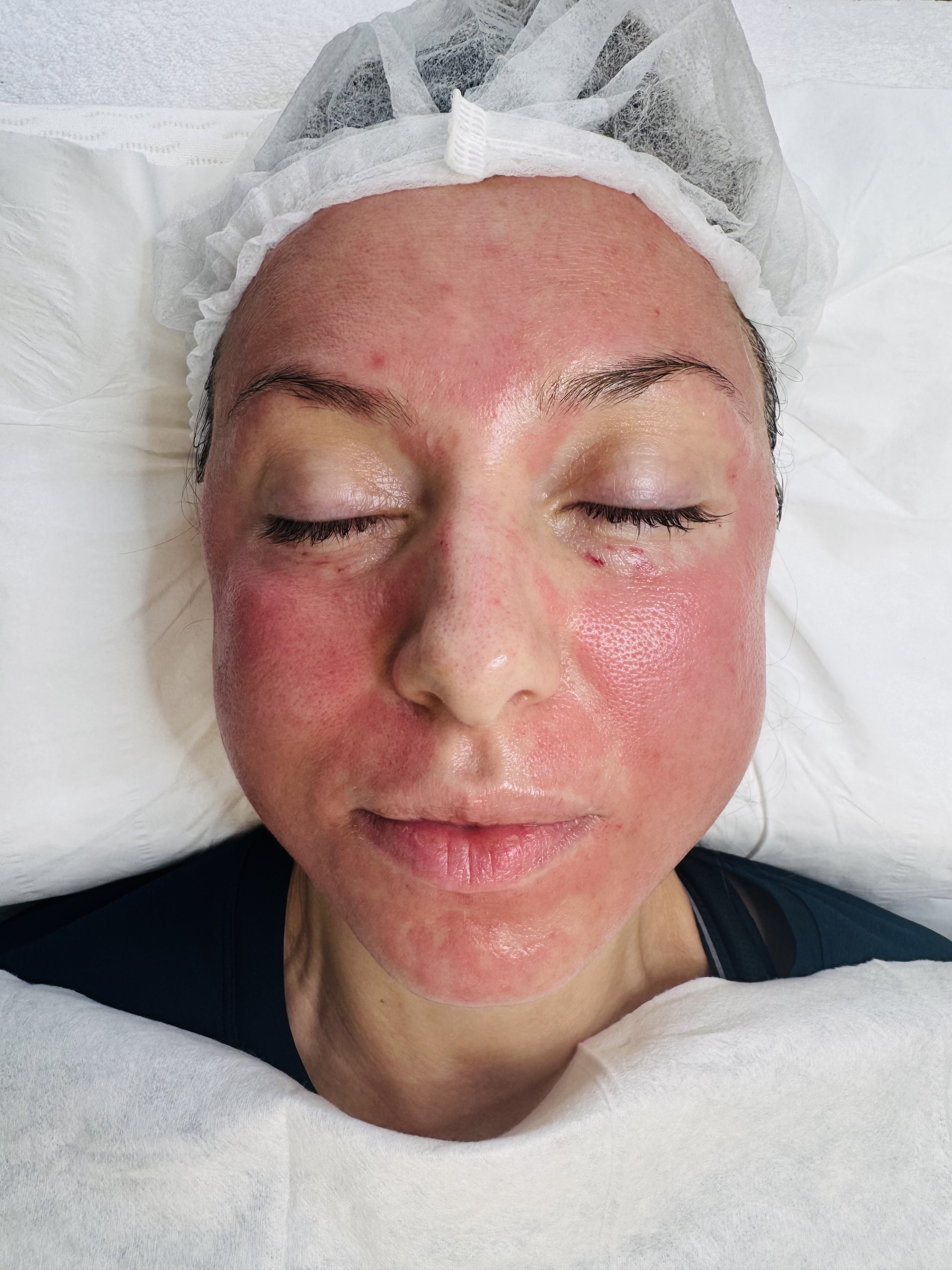
I walked out looking, to be blunt, like I'd caught a fierce bit of sun. Pink. Warm. A bit tight. By that evening the redness had calmed significantly. By the next morning I could wear light makeup, and by day two you'd never have known. That was genuinely the downtime.

Four sessions, four weeks apart
I didn't see anything after the first one. That's worth saying — because I think a lot of women go into treatments like this expecting a lightning-bolt before-and-after, and feel quietly cheated when it doesn't arrive.
Microneedling doesn't work like that. It's a slow build, because your own collagen is a slow build. The results come quietly, over weeks.
By the second session — four weeks in — I noticed my makeup was sitting differently. Better. Not perfect, but like it had something to grip onto again.
By the third, the dullness was properly gone. My skin actually reflected light, which I hadn't realised it had stopped doing.
By the fourth, four months after that first consultation, I was looking at a version of my face I genuinely hadn't expected to see again. Not younger, exactly. Better. More alive. The texture was smoother, the tone more even, the firmness visibly back. People started asking if I'd been on holidays. One friend asked, suspiciously, whether I'd had Botox.
I hadn't. That was the entire point.
The bit I keep coming back to
Near the end of my final session, Agnes said something I've thought about a lot since.
She said that most of the women who come through her door aren't really looking for a treatment. They're looking for someone to explain what's happening to them.
That landed, because it was true of me.
I hadn't walked into SaolSkin wanting a machine, or a miracle, or yet another product. I'd walked in wanting someone to take the time and tell me, honestly, why the face I'd had for forty-odd years had started feeling like it belonged to someone else — and what I could realistically do about it.
And that, I think, is the thing most of us are quietly missing.
If you're in your late thirties, your forties or beyond, and your skin has started telling you it needs something different — you're not imagining it. You're not being vain. And you have a lot more options than cream or Botox.
You just need someone honest enough to walk you through them.
SaolSkin is based in Swords, north Co. Dublin. Consultations and medical microneedling treatments with Agnes can be booked at saolskin.ie.